About the Project
Through an iterative process with Tijuana River NERR and other users, this project co-developed a biosensor system that uses shellfish (oysters and mussels) as biosentinels. Alongside land managers and other wetland and aquaculture professionals, the team designed an open-source electronic sensor that attaches to shellfish and monitors gaping behavior and heart rate. The resulting data provides a direct metric of biotic stress. The team deployed this technology in three field locations in San Diego. The biosentinels provided real-time data streams associated with a variety of changing water quality conditions, including frequent salinity and oxygen fluctuations in Tijuana River Estuary and mouth closure events in Los Peñasquitos Lagoon.
About this Resource
This resource provides a brief introduction into using biosensors and real time feedback to monitor oysters and mussels.
What is a biosensor?
The Habitat Heartbeats project developed a monitoring system that attaches to oysters and mussels and measures their heart rate and gaping behavior (the opening and closing of their shell). These metrics can be used as indicators of physiological stress in response to environmental changes. Under ideal conditions bivalves should have their shells open to filter food out of the water and respire, with a heart rate in the 10-20 beat per minute range. When conditions get stressful, the animals typically close their shells, and then lower their heart rate to just a few beats per minute, presumably to conserve energy and oxygen during these periods when they cannot feed or get oxygen from the water.
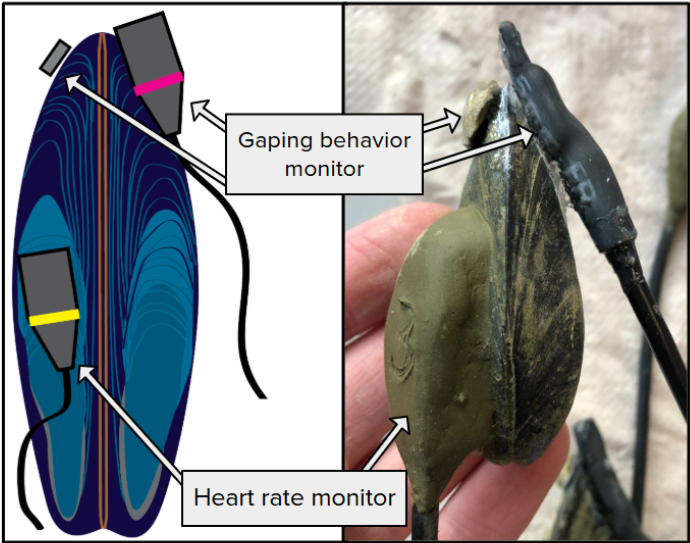
Caption: A mussel outfitted with monitors that measure heart rate and gaping behavior. The heart rate monitor records the animal’s pulse, just like a human’s pulse, using an infrared sensor that shines through the shell at the animal’s heart. The gape sensor measures the distance between the two halves of the shell - larger values indicate that the shell is open and the animal can pump water for feeding and respiration.
How do biosensors provide real time feedback?
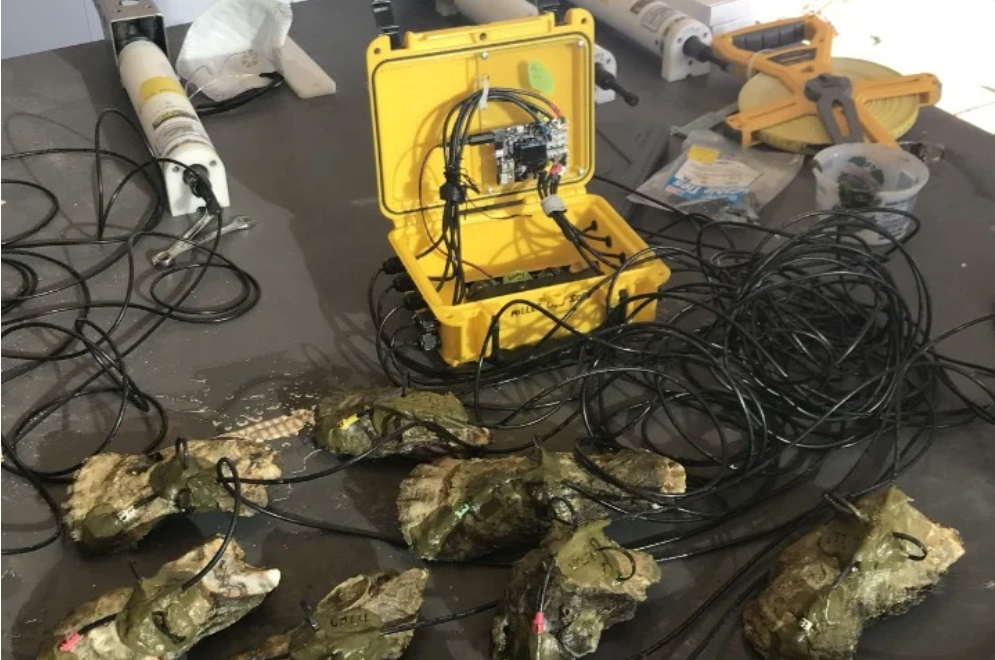
Caption: Biosentinel oysters (Crassostrea gigas) attached to a data logger prior to deployment.
Mussels and oysters outfitted with monitors can be wired to a data logger that collects and saves data about the animal’s heart rate and shell opening or closure. Once attached to a datalogger, the molluscs and their monitors can be placed in the field. The Habitat Heartbeats project deployed molluscs at multiple sites in San Diego in order to track their responses to local environmental conditions. During the project period, data collected from the deployed molluscs was sent to the project’s online data portal in real-time. Check out an archived version of the project’s data portal:
Looking for more data? The data archived at the project’s data portal site are a subset of the more detailed data stored onboard the data loggers in the field. Check out the project’s full biomonitoring datasets.
What can we learn from real-time feedback?
During summer of 2024, Tijuana River Estuary experienced higher than average river flow due to urban runoff. The runoff led to low-salinity, hypoxic (low-oxygen), and occasionally anoxic (no oxygen) water conditions in the Tijuana River Estuary. Biosentinels deployed in the estuary during the summer of 2024 showed signs of physiological stress in response to the poor water quality caused by runoff. The prolonged stressful conditions led to the death of multiple oyster and mussel biosentinels. Pollution in the Tijuana River has impacted nearby communities for decades and biosentinel monitoring tools serve to also indicate significant effects on the estuary’s health.
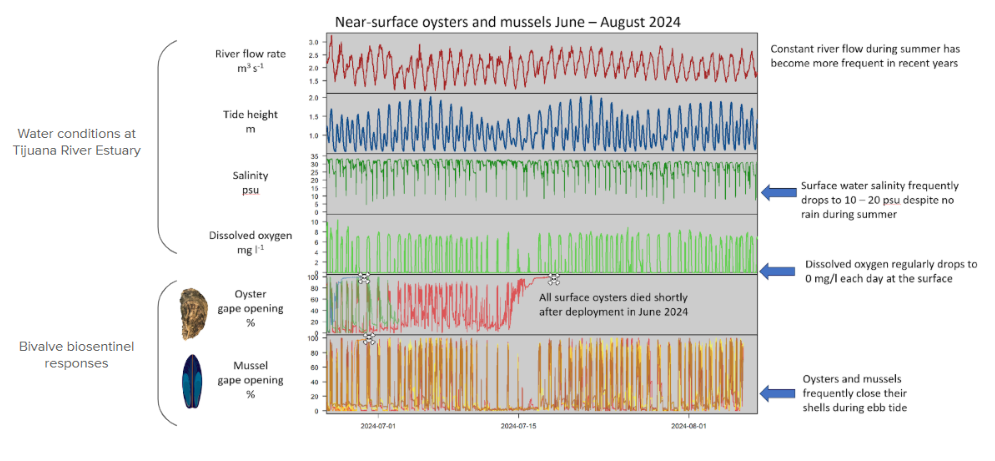
This figure compares Tijuana River Estuary water conditions with bivalve biosentinel responses during summer 2024.
The top panel shows Tijuana River flow rate measured upstream by the International Boundary and Water Commission at the US/Mexico border. Flow rates during summer should typically be zero or near-zero, but in recent years year-around river flow has become the norm due to urban runoff.
Subsequent panels show conditions at the site near the estuary mouth, including tide height, salinity, and dissolved oxygen. Salinity should remain high at the mooring site due to the proximity to the ocean, but continuous flow now leads to daily periods of low salinity during low tide. Dissolved oxygen drops to zero or near-zero during each low tide, and returns to normoxic values when ocean water returns during high tide.
The lower two panels show oyster shell opening and mussel shell opening respectively, with low values indicating shell closure. This reflects the cyclical influence of the flow as high and low tides ebb and flow. These graphs show that biosentinels are responding to low salinity and hypoxia/anoxia at low tide by closing their shells, leading to reduced feeding time and restricted respiration. Animal deaths are marked with skulls in the lower two panels.
Data from the biosentinels indicate that both oysters and mussels are responding rapidly to changes in water conditions in a dynamic estuary such as the Tijuana River Estuary, where salinity and dissolved oxygen are observed to swing rapidly hour-to-hour as the waters shift from ocean-dominated to river-dominated conditions. Bivalve biosentinels demonstrated strong potential as a concurrent biological indicator of water quality that integrates the impacts of multiple water parameters on the behavior and function of these important estuary community members.