- Watch: Full Session Recording (YouTube)
- Explore: Webinar Summary Resources
The St. Louis River Estuary, located at the headwaters of Lake Superior, is nearing a major milestone: its anticipated delisting as a Great Lakes Area of Concern by 2030. Yet even as remediation and restoration successes are celebrated, new environmental stressors, particularly harmful algal blooms, raise concerns about the estuary’s long-term water quality health. In response, a group of local, state, federal, and Tribal partners - who have long worked in, cared for, and advocated for a coordinated monitoring effort within the estuary - began calling for a science-based monitoring strategy that could respond to emerging threats and support ongoing stewardship beyond delisting. This group of partners collaborated closely with the Lake Superior National Estuarine Research Reserve to shape a shared vision: a comprehensive program of observations, analyses, and public reporting that would protect remediation and restoration investments and inform future decision-making.
The partners and project team developed a research approach that combined strong scientific design to build foundational understanding of phytoplankton dynamics with a focus on generating practical, actionable insights for a shared long term monitoring strategy. In this webinar, the project team will share more about predictors of cyanobacteria biovolume identified in the estuary and an actionable sampling approach they developed to improve bloom detection and efficient water quality monitoring into the future.
Speakers:
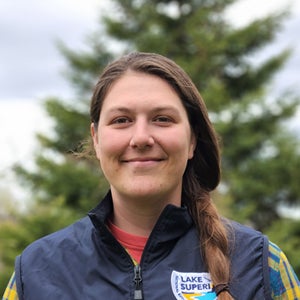 | Hannah Nicklay, Lake Superior National Estuarine Research Reserve Hannah is the Monitoring Coordinator at the Lake Reserve, where she leads collaborative research to understand water quality, algal blooms, and coastal wetland change in the St. Louis River Estuary. Her work bridges monitoring and ecological research, integrating long-term datasets, field observations, and advanced statistical analyses to inform management of Great Lakes coastal systems. As project lead, Hannah emphasizes a collaborative style that builds trust, leverages diverse expertise, and connects science to management needs. She is passionate about translating research into practical tools and partnerships that help communities and ecosystems thrive along Lake Superior. |
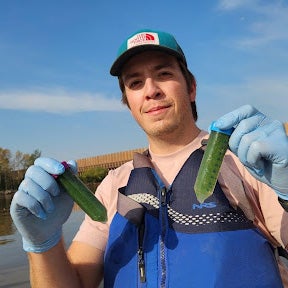 | Peter Birschbach, University of Minnesota Natural Resources Research Institute Peter is an aquatic ecology researcher with interests including cyanobacteria bloom drivers, freshwater phytoplankton community dynamics, and monitoring program optimization. He joined this project as an incoming graduate student in the University of Minnesota-Duluth’s Water Resources Science program, and successfully defended his MSc in August 2025. Peter’s contributions to this project included field work, phytoplankton identification and enumeration, analyses of spatial and temporal monitoring redundancy and environmental predictors of cyanobacteria, and written reporting. |
 | Euan Reavie, University of Minnesota Natural Resources Research Institute Dr. Reavie is a Senior Research Associate. Euan and his research team pursue research in applied aquatic studies on freshwater ecosystems, evaluating water quality issues. Routine work focuses on the use of algae as indicators of environmental changes. For this project, assessments of relationships between phytoplankton and water quality were a natural fit for his research profile. |
 | Christopher Filstrup, University of Minnesota Natural Resources Research Institute Chris is a lake and stream scientist specializing in nutrient biogeochemical cycling, harmful algal bloom ecology, and aquatic ecosystem management strategies. His role on this project focused on helping determine the overall study design, analysis of water chemistry samples, and identifying drivers of cyanobacteria blooms in the St. Louis River Estuary. |