- Watch: Full Session Recording (YouTube)
- Explore: Webinar Summary Resources
Wai (freshwater) has been historically managed by Native Hawaiian communities to sustain food security on the most remote islands on Earth. In the past century, land use and socio-economic change has transformed many of Hawaiʻi’s coastal landscapes, leading to altered groundwater recharge, storage, and transport, and reduced surface water flows. To better inform biocultural restoration and future groundwater management, this collaborative research project performed an in-depth characterization of surface and groundwater flow throughout Heʻeia.
Some of the most transformative aspects of this work were the collaborative process itself and the workshops, which strengthened relationships between researchers, resource managers, and educators and fostered a more nuanced collective understanding of how wai is linked to biocultural restoration. In this webinar, the team shares two major highlights of the study, answering the questions: How does surface and groundwater flow in the Heʻeia watershed; and what does water look like entering the coastal ecosystem?
Speakers:
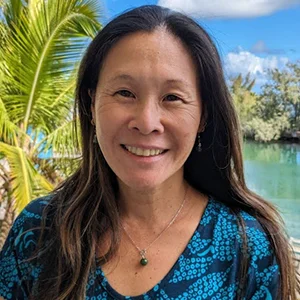 | Shimi Rii, Heʻeia National Estuarine Research Reserve Shimi is a faculty specialist at the Hawaiʻi Institute of Marine Biology at the University of Hawaiʻi at Mānoa and also leads the Research and Monitoring Program as the Research Coordinator for the Heʻeia National Estuarine Research Reserve. Her expertise spans marine ecology with phytoplankton and nutrient dynamics in estuarine, coastal, and open ocean environments. Shimi dedicates her life to facilitating and promoting reciprocal, community-driven research. She is passionate about expanding the impact of ocean science to multiple communities through the weaving of different disciplines and perspectives. Shimi served as the project lead for this project. |
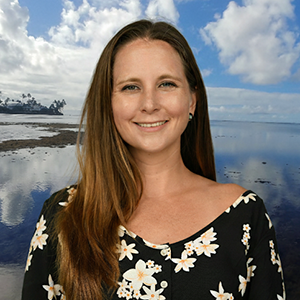 | Veronica Gibson, Heʻeia National Estuarine Research Reserve; Mālama Maunalua Veronica Gibson is now the science and planning manager for Mālama Maunalua. She is a trained ecohydrologist and phycologist, with a specialization in biocultural systems. As a postdoctoral fellow for the Heʻeia NERR, Veronica led the implementation of this project, including collaborative engagement, field measurements of biogeochemistry and hydrology, and data analysis. |
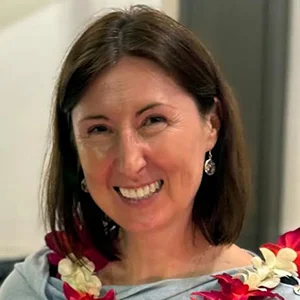 | Henrietta Dulai, University of Hawaiʻi at Mānoa Henrietta is a professor in the Department of Earth Sciences at UH. She is a geochemist and coastal hydrologist applying geochemical tracers to study surface water-groundwater interactions, saltwater intrusion, conceptual groundwater flow models, and stream hydrology. On the project she was a technical lead responsible for collaborating on formulating the science questions, creating the sampling designs, and data interpretation. |